Ecommerce platforms
Where platforms such as Shopify, Magento, WooCommerce or other ecommerce systems expose the product data we need, we can work with their existing catalogue.

Product Feed Management
Price Pilot structures, maps, validates and generates product feeds for different destinations — helping you keep product data consistent, current and ready to use across ecommerce channels.
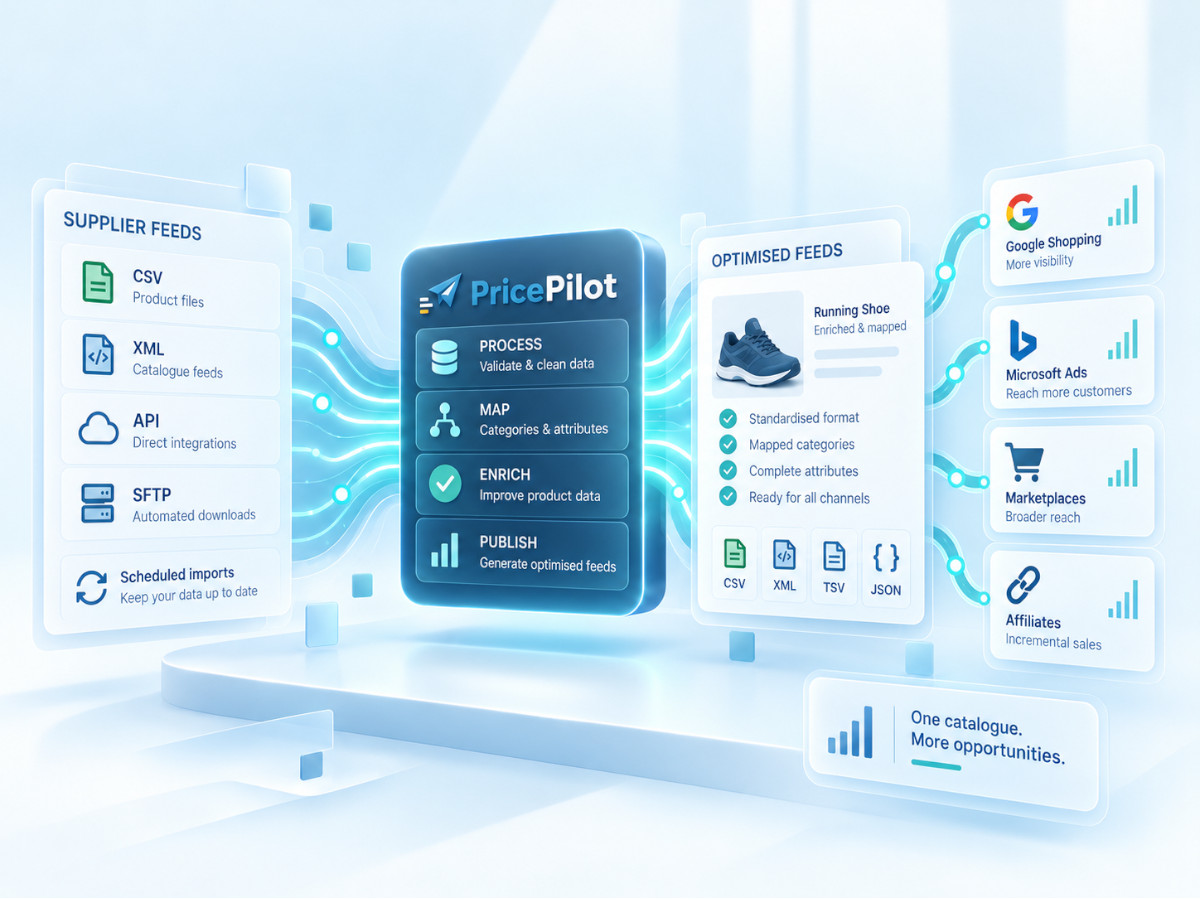
Every channel wants product data slightly differently. Fields change, categories need mapping, products go out of stock, prices move and specifications evolve.
Managing those differences manually quickly becomes difficult — particularly when the same catalogue needs to support multiple destinations.
Price Pilot creates a controlled feed layer between your product data and the platforms that depend on it.
Start with what you have
If your product data already exists in an ecommerce platform, internal system or on your website, we can often work from that directly.
That means your team does not need to design, build and maintain a new product-feed integration simply to get started.
Where platforms such as Shopify, Magento, WooCommerce or other ecommerce systems expose the product data we need, we can work with their existing catalogue.
Where an appropriate API exists, we can retrieve product, price, availability and other catalogue information directly from the source system.
Already have CSV, XML, spreadsheet or other catalogue exports? We can use those as the starting point and transform them for downstream destinations.
Where appropriate, product information can also be collected from the merchant website when there is no usable feed or catalogue integration available.
Feed management
We take your source product data, apply the rules each destination requires, validate the resulting records and generate feeds that are ready for use.
Map product fields into a consistent feed structure, including controlled transformations, fallbacks and destination-specific naming.
Check required fields, formats and field lengths before products are published, while isolating individual records that need attention.
Control which products and offers belong in each feed using product, supplier, availability, price and other criteria.
Produce feed files on demand or automatically to a schedule, ready for downstream systems to consume.
Flexible output
Different destinations may require different fields, structures, delimiters or subsets of your catalogue. Price Pilot lets those variations share the same underlying product data rather than maintaining a separate catalogue for every channel.
The output format is only one part of the job. Field naming, transformation, validation, filtering and destination-specific rules can all be managed independently for each feed.
Delimited text feeds including comma-separated CSV, tab-separated TSV, semicolon-separated, pipe-delimited and other agreed delimiters.
Structured XML feeds for destinations and integrations that require XML product data.
Excel-compatible workbook output where a spreadsheet format is more useful for the receiving team or platform.
Different feeds can expose different columns, names, transformations and subsets of the same catalogue without duplicating the underlying product data.
We start with the product data you already have, whether that comes from a feed, platform, API, database export or website.
Fields are mapped, transformed, filtered and formatted according to what each receiving platform requires.
Required fields and formatting rules are checked before publication, with problematic records identified for review.
Feeds can be generated manually or automatically, monitored over time and adapted as catalogue or destination requirements change.
Automation
Product data does not stand still. Price, availability, catalogue changes and destination requirements can all make a previously correct feed stale.
Feed generation can be scheduled independently for each destination, helping downstream platforms receive current data without repeated manual exports.
Publication history and rejected-row diagnostics make it easier to see what happened during each generation and where individual products need attention.
COMMERCIAL MODEL
Our preferred model is commission-based, so merchants with lower feed-driven performance pay less rather than carrying a large fixed management charge.
We agree a maximum charge for each feed in advance. That gives larger merchants cost certainty while keeping the commercial model proportionate for smaller or lower-performing feeds.
The result is not simply another export file. It is a repeatable, controlled way to turn catalogue data into outputs that different platforms can reliably consume.
The same underlying catalogue can support multiple destinations without maintaining separate copies.
Invalid records can be identified before they become downstream feed problems.
Scheduled generation reduces repeated manual work and helps keep destination feeds current.
Publication history and diagnostics provide a clearer operational view of every managed feed.
Show us where your product data lives today and which destinations you need to support. We can work out the most practical way to turn it into reliable managed feeds.